
Spice N Flavor — Bringing Indian Flavors to America
From the spices of India to the kitchens of America — and from the kitchen to a mission for a less wasteful food system
Chef Tom Vellaringattu's journey with Spice n Flavor began long before the restaurant opened its doors in California. It grew from a simple idea: share the authentic flavors of Indian cooking with people beyond India. With formal culinary training and years of experience across Indian and international cuisine, Tom understood that spices were more than ingredients — they were the foundation of regional identity, family traditions and memories.
2000
Best Packaging Award
Indian Institute of Packaging
6
Best Taste Awards for Curry Mixes
Culinary Federation of America, 2000
10+
Signature Spice Blends
India's Spice n Flavor
11,000+
Orders Fulfilled via Shef
SF Bay Area, through 2021
From India to New York
In 2000, Chef Tom founded Spice n Flavor in New York, beginning an entrepreneurial journey focused on Indian spice blends. Under the brand India's Spice n Flavor, he developed and introduced more than ten spice blends based on his own recipes and deep culinary knowledge.
The goal was to make the distinctive flavors of Indian cooking easier for American consumers to discover and enjoy at home. His distinctive packaging earned the Best Packaging Award from the Indian Institute of Packaging in 2000, and six of his curry mixes won Best Taste awards from the Culinary Federation of America that same year.
Rather than simply selling individual spices, the blends were designed around the way Indian cooks actually prepare food — carefully selected combinations that create recognizable regional flavors. Though nationwide shipping costs eventually challenged the business, it gave Tom a deeper understanding of food entrepreneurship, product development and building a food business in America.
From Spice Blends to the Restaurant Kitchen
Years later, Spice n Flavor evolved from a packaged-spice concept into a restaurant. In 2016, Chef Tom opened Spice n Flavor in San Jose, California, bringing his culinary experience directly to the table.
The restaurant focused on Kerala and South Indian cuisine, introducing Silicon Valley diners to dishes deeply connected to Tom's own background. Kerala cuisine is remarkably diverse — shaped by its tropical environment, coastal geography, agriculture and centuries of cultural exchange.
For Tom, cooking Kerala food was never simply about recipes. It was about preserving and sharing a culinary heritage, and turning food into a bridge between cultures.
A New Kind of Food Business
While operating the restaurant, Chef Tom became involved with Shef, an online platform connecting home chefs and customers. He helped introduce his cooking to their community through repackaged dishes from Chef Tom Vellaringattu — a new way for people to experience his food beyond the traditional restaurant setting.
This was an early example of something that would become increasingly important to Tom: using technology to connect food with people. Instead of relying solely on a physical restaurant, food could travel through a digital marketplace and reach a much larger community.
More Than 11,000 Orders
Across roughly four years with Shef, Chef Tom fulfilled more than 11,000 orders throughout the San Francisco Bay Area through the end of 2021. Each order represented several dishes — and far more than a transaction.
Every order was another opportunity to introduce someone to Indian cuisine, share a family recipe and build a connection through food. It also offered an unusual education in the logistics of food at scale — how food is prepared, packaged, ordered, transported and consumed, and how much of it is wasted along the way. Those lessons would later shape Tom's thinking about food waste and the food ecosystem.
Silicon Valley & the Food-Technology Connection
Operating in the Bay Area placed Chef Tom in the middle of one of the world's most innovative technology communities — where food and technology were increasingly intersecting. Consumers discovered restaurants through smartphones, meals were ordered online, and home chefs found customers through digital platforms.
Tom saw the possibilities. If technology could help a chef reach thousands of customers, perhaps technology could also help solve larger problems facing the food system. What if technology could connect food that exists with people who need it? That question would eventually become part of the thinking behind Food Pulse.
From Spice n Flavor to Food Pulse
In early 2022, Chef Tom moved to Portland, Oregon, beginning another chapter and continuing to explore the intersection of food, technology, community and sustainability. By then the question had grown larger than simply how to make great food — it had become: how can we help people discover, share, value and waste less food?
Spice n Flavor began with the flavor of food. The restaurant explored its culture. The digital experience explored its distribution. Food Pulse now looks at the entire food ecosystem — from farmers and fishermen to grocery stores, home gardens, food banks, volunteers, cooks and consumers.
At the center of that vision is a simple belief: every good ingredient deserves a chance to become a good meal. Food should nourish people, connect communities and preserve culture — and whenever possible, feed people rather than become waste. Spice n Flavor was the beginning of the journey. Food Pulse is the next chapter.
Each Stage Taught Something New
Our Kitchen Values
Authenticity First
No shortcuts, no fusion gimmicks — only recipes that honor tradition and taste true to their roots.
Fresh & Wholesome
We cook with seasonal produce, cold-pressed coconut oil and freshly ground spices, the way it's meant to be.
Cooked with Love
Every recipe is tested in a real home kitchen and shared with the warmth of family tradition.
Food, Not Waste
From spices to sustainability — we believe every good ingredient deserves to become a good meal.
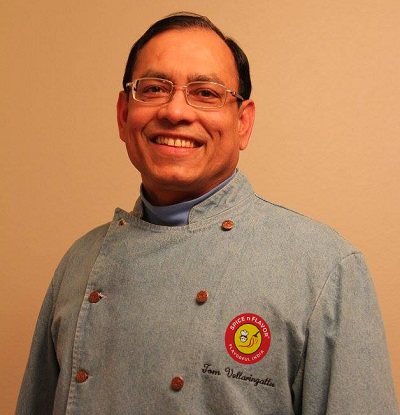
Meet Chef Tom Vellaringattu
A trained chef, food entrepreneur and food-community advocate whose journey has taken him from professional culinary training in India to building food businesses in the United States — and now toward a broader mission: helping people value food, connect around food, and waste less of it.